No, You Don't Need Self-Locating Evidence.
The whole framework of Self-Locating/Non-Self-Locating evidence is completely unhelpful and only creates confusion.
Introduction
For a long time, I was planning to write a comprehensive post patiently exploring all the problems with conventional “anthropic reasoning”. How, for historical reasons, the whole discipline went sideways at some point and just can’t recover, continuing to apply confused frameworks, choosing between several ridiculous options and accumulating paradoxes. And how one should reason correctly about all the “anthropic problems”.
I’m sorry but this post isn’t going to be that. This time I’m mostly getting the frustration out of my system because of Bentham's Bulldog’s You Need Self-Locating Evidence! which confidently reiterates all the standard confusions, even though he really should know better at this point.
So, in this post I’ll resolve only some of the confusions of “anthropic reasoning”, leaving others as well as the deeper historical analysis for the future. Frankly, maybe it’s even for the best.
Probability theory 101
My apologies, but this section is necessary, as it’s exactly the sloppy probabilistic reasoning that led us to the current miserable state. I promise to be brief with this section1.
Let’s start from explicitly defining what probabilities are. Probability theory gives us a mathematical model to approximate some causal processes from reality to some degree of uncertainty.
It’s very helpful to think in terms of maps and territories here. We look at some territory in the world and create an imperfect map of it. The less we know about the territory the more generic is the map. And when we learn new details, we add them to our map, making it more specific.
Consider a roll of a fair 6-sided die.
Imagine an infinite number of iterations where the die is rolled again and again - a probability experiment representing any roll of a fair 6-sided die. Every trial has an outcome: either ⚀ or ⚁ or ⚂ or ⚃ or ⚄ or ⚅. This set of mutually exclusive and collectively exhaustive outcomes of the probability experiment is called the sample space.
Sets of these outcomes are called events. The simplest are individual events, consisting only of a single outcome, but likewise there can be events consisting of any number of outcomes up to the whole sample space.
Events can be interpreted as statements that have truth values in every iteration of the experiment. For example, event {⚁; ⚃; ⚅} is interpreted as a statement:
“In this trial the die is even”.
Naturally, this statement is True in every iteration of the probability experiment that the die is either ⚁ or ⚃ or ⚅ and False in every other iteration. Probability of an event is a ratio of trials where this event is True to the total number of trials throughout the whole probability experiment.
With this in mind, let’s answer a simple question. What’s the probability that our die rolled a ⚅?
At first, we are completely indifferent between all of the iterations of the probability experiment. Our roll can be any of these infinitely many trials. But we know that 1/6 of them are ⚅. Therefore:
P(⚅) = 1/6
Now, suppose we’ve learned that the outcome of the roll is even. This gives us new information, makes our map more specific by eliminating half of the possible outcomes. Now we are indifferent only between the trials where the outcome of the die roll is even and 1/3 of them are ⚅, therefore:
P(⚅|⚁; ⚃; ⚅) = 1/3
If you can understand that, accept my congratulations, you understand probabilities better than most of the philosophers of probability. I wish I was joking.
Possible Worlds, Impossible Confusions
Philosophers do tend to overcomplicate things sometimes. For reasons, I’m not going to dwell on right now, instead of outcome of a probability experiment, they decided to talk about “possible words” and then “centred possible worlds”, completely confusing themselves and everyone else.
As a part of this confusion, they came up with the notions of “Self-Locating” and “Non-Self-Locating Evidence”. Here is what BB tells us about this framework:
People often think probabilities and beliefs merely concern how the world is.
I think this is wrong.
Self-locating probabilities are probabilities that concern one’s place in the world, rather than what the world is like.
We may immediately come up with couple of corrections. First of all, probabilities are not just about the way the world is. They are about some aspects of the world to the best of our knowledge. That’s why probabilities change when we learn new facts even though the territory we are describing may stay the same.
And, whether a particular person is positioned in the world is also a fact about the world, so the whole distinction makes no sense even in its own terms. A world where I’m in one city is different from the world where I’m in some other city. Obviously. So, case closed?
Oh, not so fast! You see, as an additional complication, that would confuse everyone even more, philosophers have long ago added here the notion of personal identity:
For example, imagine that there is one clone of me in a dark and murky bunker in California and another in Paris (what rotten luck). I have no special evidence concerning which one I am (for example, there are no nearby croissants or people surrendering). I should think there’s a 50% chance that I am the one in California.
This evidence is self-locating because it’s not about what the world is like. I already know what the world is like. I know that there is one copy of me in California and another in Paris. What I’m uncertain about is which one I am. That’s what self-locating information concerns: which of the people you are, not what the world is like.
That is, in what sense are two worlds different if we switch the places of two completely identical people?
And, fair enough, it’s an interesting question in its own right. We can say that “switching places” isn’t a free action. We need to exert some work, which increases entropy in the universe. Therefore, the world where such switching has happened is different from a world where it didn’t. In the very least, they have different causal stories.
But more importantly, none of this matters in the slightest when talking about probabilities.
Once again, probability theory describes some real-world situation to the best of our knowledge. In the example above the situation is “either being in one place or the other” and the best of our knowledge is “no evidence whatsoever”.
So, we have a probability experiment with two mutually exclusive outcomes. In half of the iterations, I’m in Paris and in the other half - in California and I’m uncertain between all of them. Therefore:
P(California) = P(Paris) = 1/2
That’s all. It doesn’t matter whether there is or isn’t a clone in the other location. It doesn’t affect anything. Neither we need to think about some alternative worlds and whether they are real and in which sense. It is completely irrelevant to our probabilistic model. There is absolutely no difference in methodology between this example and the 6-sided-die example from the beginning of the post. We don’t need a special category “Self-Locating Evidence” to talk about such probability experiments; it’s a completely useless concept.
The Crux
Wait, doesn’t it mean that I essentially agree with Bentham’s Bulldog? Sure, I’m annoyed with his terminology and the framework he is applying, but it’s just formalism what about the substance? He argues that “Self-Locating Evidence” is not fake and we should treat it as any other evidence:
But a number of people have suggested that self-locating evidence is sort of fake. They claim that it doesn’t make any sense to wonder who I am once I know what the world is like. After all, there’s a copy of me in each situation. What can I possibly be wondering about if not what the world is like?
In this article, I’ll explain why self-locating evidence is real.
I claim that we shouldn’t even have a separate category for this sort of stuff in the first place, because all probabilistic reasoning works the exact same way in terms of probability experiment. What am I even arguing about?
Let’s make it clear with a handy Venn Diagram:
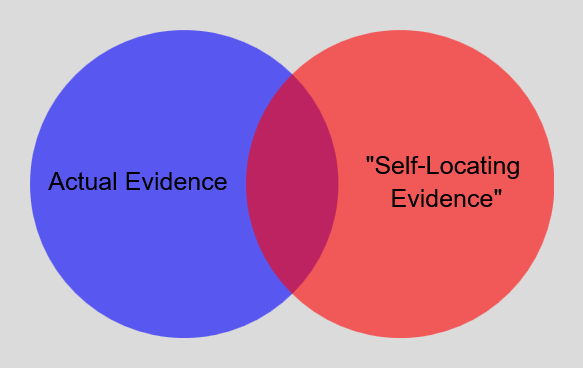
The problem with the “Self-Locating Evidence” category is that, while some part of it is just completely normal probabilistic reasoning, the other is total nonsense that goes against the core principles of probability theory and is a source of constant stream of paradoxes.
People who say that “Self-Locating Evidence” is “sort of fake” are not wrong - a huge part of it is. But due to conversation being framed in either pro- or anti-self-locating-evidence way, expressing this nuanced point is hard.
As a result, someone like BB can come up with an example of “Self-Locating Evidence” producing valid reasoning and then falsely generalize it to a domain where it doesn’t work. And when you try to point this out, such person just says:
“What do you mean probability theory doesn’t work like that? Haven’t you heard about Self-Locating Evidence? Are you denying that I can have some credence whether I’m in Paris or in California? That’s crazy!”
That’s why the term should be abolished and we should just be talking about all the probability theoretic problems in a unified way in terms of probability experiments and their trials.
Memory Loss Problems
The class of problems where self-location-evidence become nonsensical are the problems which involve memory loss and repetition of the same experience during the same iteration of probability experiment.
The most famous example of which is, of course, the Sleeping Beauty problem. I have a whole series of posts where I explore it with all the details it deserves. If you are interested, you may start here.
But the short version is that if we reason about Sleeping Beauty the standard way, everything is quite simple. There are two mutually exclusive and collectively exhaustive outcomes of the experiment:
The coin is Heads so you are to be awakened on Monday - Heads&Monday
The coin is Tails so you are to be awakened on both Monday and Tuesday - Tails&Monday&Tuesday
In half of the trials the first outcome happens, in the other half - the second one. And we are uncertain between all the trials of the experiment.
When we are awakened, this doesn’t eliminate any of the trials of the experiment - we are awakened in every one of them, so we keep being as uncertain as ever. The same goes for being told that you were awaken on Monday - Monday awakening happens in every trial, so it doesn’t provide any update. Therefore:
P(Heads) = 1/2
P(Tails) = 1/2
P(Awake) = 1
P(Monday) = 1
P(Tuesday) = 1/2
P(Heads|Awake) = 1/2
P(Heads|Monday) = 1/2
Everything perfectly adds to normality; there are neither paradoxes nor money-pumps.
However, when people start to apply the notion of “Self-Location” to the Sleeping Beauty - thinking that, during the experiment, she is supposed to have some credence in such statements as “Today is Monday” - all hell breaks loose.
We get single halfers who, if told that “Today is Monday”, start believing that they can predict the outcome of a future fair coin toss better than chance.
Or thirders for whom fully expected fact of awakening in the experiment shifts both their probabilities and utilities.
And we also get the never-ending debate where both of these types of reasoning are generalized into sampling assumptions, and then mindlessly applied to all the problems which look similar, producing more paradoxes and confusion.
Why does this happen here, while everything was completely fine with the Paris/California example? Is it because previously it was about self-location in space, while now we are talking about self-location in time?
No. Not at all. We can just as well come up with a valid reasoning about your place in time. Consider this:
You go to sleep on Sunday. A fair coin is Tossed. On Heads you are awakened on Monday. On Tails you are kept asleep on Monday and are awakened only on Tuesday. You are awakened. What is the probability that today is Monday?
Here, everything is completely normal. Being awakened on Monday and on Tuesday are two mutually exclusive outcomes of the experiment - on every trial only one of them happens. Half the trials are the ones where the coin is Heads and you are awakened on Monday. You are equally uncertain between all the trials. Therefore:
P(Today is Monday) = P(Heads) = 1/2
Notice, how we can clearly say that “Today” here means “"Whatever day the awakening happens in this trial” or, in other words - “Monday xor Tuesday”.
Meanwhile in Sleeping Beauty the notion of “Today” is ill-defined. It doesn’t mean “Monday”, because some awakenings are on Tuesday. It doesn’t mean “Tuesday”, because some awakenings are on Monday. It doesn’t mean “Monday xor Tuesday” because awakenings in both days can happen in the same trial.
As a result, statements like “Today is Monday” do not have a stable truth value during every trial and so we can’t measure their probability. There is no set of outcomes of the experiment that correspond to them. They are formally not events.
The issue is not that this is a “self-locating” problem. Or that it’s about time. These are all red herrings. The issue is that probability theory deals with uncertainty between different trials not within the same trial of the probability experiment.
It’s a formal system with clear rules. And if you start twisting them, defining sample spaces from not mutually exclusive outcomes, for instance, you are not talking about probability anymore.
Devastatingly Bad Arguments
As far as I can tell, Bentham’s Bulldog couldn’t care less about all these theoretical concerns regarding well-definition of events and other mathematical formalism.
His modus operandi is to apply Self-Indexing Assumption everywhere, whether it makes sense or not. And as SIA is nothing but a generalization of thirdism in Sleeping Beauty, of course he also believes that one should update on “self-locating evidence” in memory loss problems.
As an argument for this he brings up a paper A Devastating Example for the Halfer Rule by Vincent Conitzer with a modified version of the Sleeping Beauty problem:
Here’s the idea: suppose that you’re woken up on two consecutive days. Each day, a coin gets flipped, and you see its results. On the second day, you don’t have any memory of the first day. After waking up, you see the coinflip (let’s say it is heads). How likely should you think it is that the coin comes up heads once and tails once?
Both BB and Conitzer are sure that the answer is 1/2 and that one requires applying “self-locating evidence” to arrive to this conclusion:
The obvious answer is 1/2. If you flip two fair coins, the odds of it coming up heads once and tails once are 1/2. Seeing the results of today’s coinflip doesn’t tell you anything new, because you knew you had to see either heads or tails, and neither one was special.
But you can’t do this if you reject self-locating evidence. The four possibilities are: HH, HT, TH, TT. They each have the same prior probabilities. Seeing today’s coin came up heads eliminates TT. On the view that rejects self-locating evidence, it simply makes no sense to say that today’s coinflip is likelier to be heads if both coins come up heads. After all, it makes no sense to attach probabilities to today’s coinflip coming up some way, if you already know what the world is like—if, in other words, you already know that the coin comes up heads at least once.
Thus, absent self-locating evidence, TT is eliminated and each of the three options has 1/3 of the remaining slice of probability. That means that the odds of HH is 1/3, not 1/2. Because the view that rejects self-locating evidence can’t update in favor of HH based on today being heads, it has to revert to priors. But most of the worlds containing at least one heads waking, on priors, are worlds with one heads and one tails.
The claim that seeing the results of today’s coinflip doesn’t tell me anything new is, frankly, bizarre. Especially, considering that then BB himself precisely describes the updating procedure that takes place, due to elimination of the trials where no coin came up the side I’ve observed. But let’s put a pin into that.
No less bizarre is how one person can write a whole paper on probability theory and another person read it. And neither of them noticed that this paper has reinvented the famous Boy or Girl Paradox, to which 1/3 is well-known to be a completely valid answer.
And then on several previous occasions I’ve told Bentham’s Bulldog about it. And yet he still posts an article claiming that the answer 1/3 is crazy and violates the principle of reflection:
The first big problem is that it’s totally crazy. It shouldn’t be that in the above case, you are guaranteed, after seeing the results of the coinflip, to think at 2/3 odds that the coin came up heads once and tails once.
It also has the problem that it violates a principle called reflection. Reflection says that your credence shouldn’t predictably go up. It shouldn’t be, for example, that your credence is 1/2 now but you know that later it will be 3/4. If you know there’s evidence out there that will raise it to 3/4 then it should be at 3/4 now, in anticipation of that evidence.
Figuring out exactly how to formalize reflection is a bit tricky, but this example seems pretty egregious. The person is guaranteed after waking up, no matter what day it is, to adopt a credence of 2/3 in the coin coming up heads once and tails once.
The latter accusation is always rich coming from a thirder in Sleeping Beauty who predictably updates on awakening that is guaranteed to happen in every trial.
Meanwhile, here - it’s time to remove our pin - we actually receive new information, whether at least one coin is Heads or at least one coin is Tails, eliminating either TT or HH trials from the probability experiment, which we didn’t know before observing the coin.
Likewise in the next scenario, which Conitzer claims to be the most egregious violation of the reflection principle:
To make matters yet worse for the Halfer Rule, consider the following twist to the two-coins example. On both Monday and Tuesday, after Beauty has observed the coin toss outcome and been awake for a little while longer, the experimenter tells her what day it is. Say she observed Heads and was then told (a bit later) that it is Monday. Now only two worlds survive elimination: HH and HT. The Halfer Rule will assign each of them credence 1/2, resulting in a credence of 1/2 that both coins came up the same. But this is yet another violation of the Reflection Principle: after seeing the outcome of the coin toss but before learning what day it is, Beauty, if she follows the Halfer Rule, places credence 1/3 in the event that the coins came up the same, but she also knows that once she is told what day it is, in either case, she will shift her credence to 1/2. This is perhaps the most egregious violation of the Reflection Principle that we have encountered, because in this case she is not put to sleep and does not have memories erased as she transitions from one credence to another.
The Beauty receives new relevant information. Of course she updates! Instead of knowing that at least one coin is Heads, she now learns that the first coin in particular is Heads. That’s completely reasonable behavior, mirroring the difference between learning that at least one child is a boy and that the first child is a boy in the Boy or Girl paradox.
It’s as if both Conitzer and BB forgot that it’s possible to update one credence not due to memory loss but also due to receiving new evidence. Truly devastating.
Betting Argument
BB also threatens that Beauty in Conitzer’s setting can be money pumped unless she updates on “self-locating evidence”, but conveniently refuses to make an example of such pump. When he actually does that, I’ll be happy to engage with the argument further. For now, however, let me provide a clear demonstration why probability measure of 1/3 for the other coin being Heads if the current one is Heads is completely reasonable.
Here we have a Python code for multiple iterations of the experiment with a per trial betting scheme. In every trial where Beauty observes that at least one of the coins is Heads she can agree to bet at 2:1 odds that the other coin is also Heads.
score = 0

for i in range(10000):
    coin1 = random.choice(['Heads', 'Tails'])
    coin2 = random.choice(['Heads', 'Tails'])

    if coin1 == 'Heads':
        if coin2 == 'Tails':
            score -= 1
        else:
            score += 2
    else:

        if coin2 == 'Heads':
            if coin1 == 'Tails':
                score -= 1
            else:
                score += 2

print(score)
Feel free to execute this code several times and notice that the bet is netral for the Beauty, which implies 1/3 probability for both coins being Heads.
But what if the bet is proposed not once per trial but on every awakening? This means that her utility on HH outcome is doubled as she wins two bets instead of losing only one on HT and TH outcomes. This gives us 1:1 betting odds for HH without any changes in probabilities. And indeed:
score = 0

for i in range(10000):
    coin1 = random.choice(['Heads', 'Tails'])
    coin2 = random.choice(['Heads', 'Tails'])

    if coin1 == 'Heads':
        if coin2 == 'Tails':
            score -= 1
        else:
            score += 1

    if coin2 == 'Heads':
        if coin1 == 'Tails':
            score -= 1
        else:
            score += 1

print(score)
Let’s also show that learning that it’s the first coin that is Heads, in particular, gives the Beauty a completely rational probabilistic update:
score = 0

for i in range(10000):
    coin1 = random.choice(['Heads', 'Tails'])
    coin2 = random.choice(['Heads', 'Tails'])

    if coin1 == 'Heads':
        if coin2 == 'Tails':
            score -= 1
        else:
            score += 1

print(score)
Here she is neutral at 1:1 betting odds, which corresponds to P(HH|Monday) = 1/2.
Conclusion
As we can see, despite all the scaremongering, Beauty behaves in a completely reasonable way without any need for so called self-locating evidence. She doesn’t need them at all.
And neither do you, my dear reader. All their valid applications are already captured by standard reasoning about iterations of probability experiment. And all the invalid ones are just spreading confusion that makes people write bad philosophical papers.
On the other hand if you’d like to dig deeper into probability theory nuances, I may have a couple of posts for you.
I read your series on Sleeping Beauty a while ago, and I thought it contained an excellent set counterarguments against prevailing anthropic wisdom. But even though I found your conclusions very convincing at the time, I’ve come to find myself disagreeing with them more and more, and the same objections apply to the parts of this piece discussing Sleeping Beauty.
Regardless of whatever arguments BB has been making (I haven’t read his latest posts on the issue) I don't think defining your solution only with “probability that a Monday wake up happens” is sufficient as a solution to the Sleeping Problem. Whatever arguments you might make, the fact remains that a bookie could, hypothetically, approach Sleeping Beauty when she wakes up and offer her odds on the bet “today is Monday.” This is a perfectly cogent question, and one that would obviously have a definitive answer of either “yes” or “no” at any given time.
But using your particular Double Halfer logic, the Beauty would have to either accept any bet that pays on Monday - since Monday happens no matter what - or more likely simply refuse to bet because she believes the question "is it Monday" to be somehow ill-defined. Both options are underwhelming.
Now, I agree that the SIA and especially the SSA are totally broken, but it seems to me that your preferred solution throws out the baby with the bathwater. Yes, our existing methods clearly aren’t sufficient to handle the questions we want to answer; but that doesn’t mean asking the question is somehow invalid. I think the true answer simply lies elsewhere.
Great post!
>>"I claim that we shouldn’t even have a separate category for this sort of stuff in the first place, because all probabilistic reasoning works the exact same way in terms of probability experiment."
Totally agree; I feel this way even more strongly about "SIA" and "SSA"--as if the first two models people bothered to give names to when thinking about some weird problems necessarily partition the whole space of "approaches to problems where you update on your existence".
It's like if two people saw a calculus problem and one of them insisted that you have to be an Integralist to solve it; and the other said, no! you have to be a Derivativist! When obviously the correct answer is: you should think about the structure of the problem on its own terms, and use whatever tools seem best.
In these cases, it really does all come down to how you model things, and the difficulty of thinking clearly about the structure of your model and the nature of your updates. It's all just one big Bertrand's paradox, except if people had strong, hard-to-formalize intuitions about the natural way to draw chords on a circle.
>> "That’s all. It doesn’t matter whether there is or isn’t a clone in the other location."
and
>> "The problem with the “Self-Locating Evidence” category is that, while some part of it is just completely normal probabilistic reasoning, the other is total nonsense that goes against the core principles of probability theory and is a source of constant stream of paradoxes.
[...]
That’s why the term should be abolished and we should just be talking about all the probability theoretic problems in a unified way in terms of probability experiments and their trials."
As above, hard agree, and we should all just present how we're modeling things rather than talk about whether we believe in "SLA" or "SIA" or whatever.
The observation that the presence of the other clone doesn't matter really shows that all the work is being done by your theory of personal identity: how you model who "you" are/could have been makes all the difference, so just talk about that model instead of distracting yourself with nonsense.
With all that said...How to model personal identity isn't obvious or trivial! And I'm still not convinced that your approach to modeling these things is convincing in all cases! But I'll save that for another comment...